


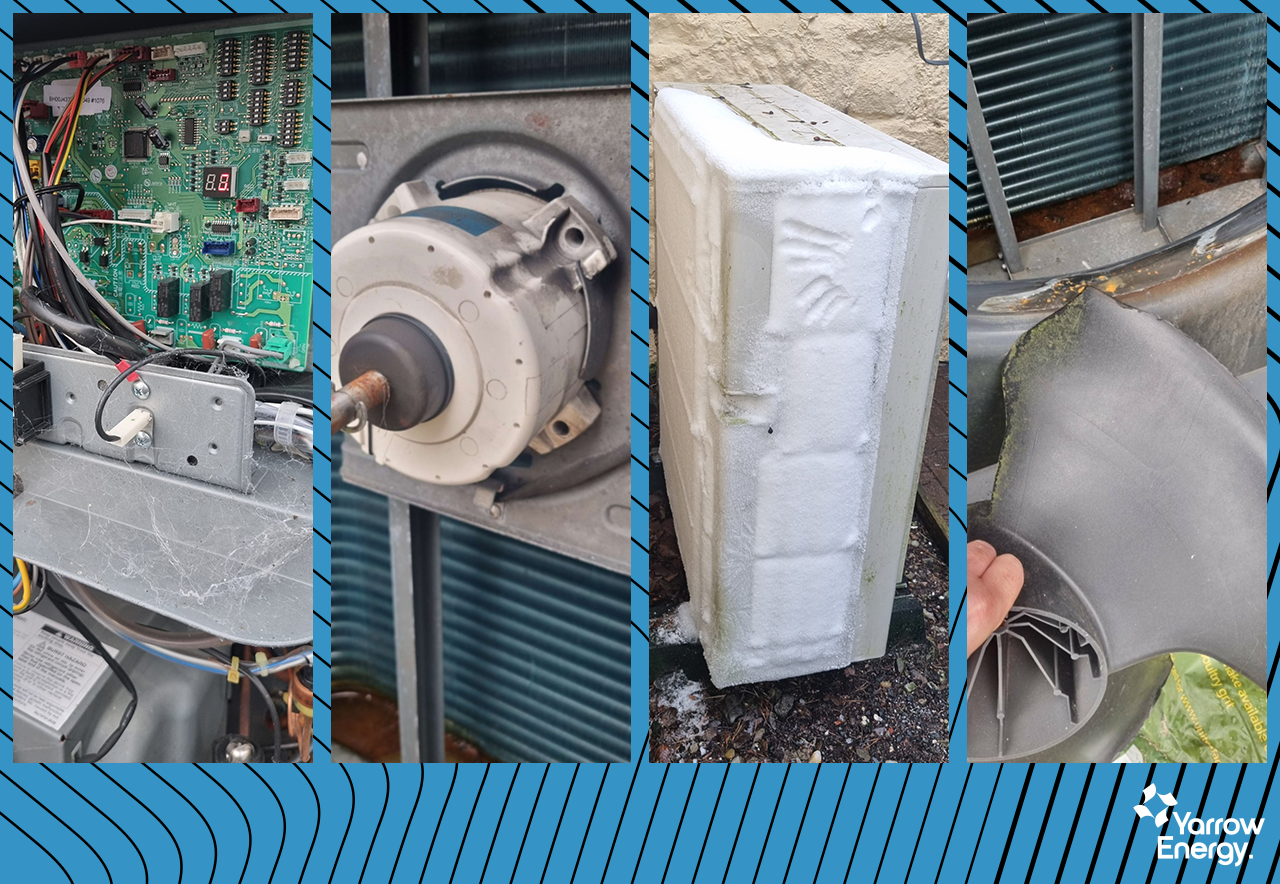
We were recently called out to investigate a broken-down air source heat pump. When we arrived, the outdoor unit was heavily iced up. The back of the heat pump was thick with frost.
We were recently called out to investigate a broken-down air source heat pump.
When we arrived, the outdoor unit was heavily iced up. The back of the heat pump was thick with frost.
That frost kept building until it physically stopped the fan from turning.
The end result wasn’t minor:
- Fan motor damaged
- Fan blade broken
- PCB blown
That’s not a small repair bill.
And the frustrating part is that it was entirely avoidable.
A Bit of Frost Is Normal
A light layer of frost on the back of an air source heat pump, specifically the evaporator coil, is completely normal in colder weather.
Your heat pump is designed for it.
During normal operation, the system will periodically run a defrost cycle. It temporarily reverses operation, melts the frost, then carries on heating as normal. Most homeowners never even notice it happening.
Frost on its own isn’t a problem.
How the system deals with it is what matters.
When Frost Becomes a Warning Sign
When frost becomes excessive, thick, or persistent, it usually means the heat pump is no longer defrosting properly, or it’s running outside its normal operating conditions.
Common causes include:
- Low refrigerant charge due to gas loss
- Faulty 4-way reversing valve (defrost valve)
- Expansion valve issues, including EEV or TXV faults
- Airflow restrictions or coil blockage
- Sensor faults or incorrect temperature readings
In this particular case, the cause turned out to be simple.
A faulty sensor.
The heat pump wasn’t “seeing” the conditions correctly, so it wasn’t controlling defrost the way it should. Frost kept building, airflow dropped, and mechanical stress increased until multiple components failed.
We suspect that sensor had been failing for some time, meaning the unit had likely been running inefficiently long before it fully broke down.
How a Service Would Have Prevented This
A basic annual service would almost certainly have flagged the issue early.
During a routine service, we would typically:
- Check sensor readings against expected values
- Assess defrost behaviour during operation
- Verify overall system performance and control logic
That early detection would have meant a small, low-cost fix.
Instead, a single unchecked fault cascaded into multiple failures.
The Real Reason Annual Servicing Matters
Servicing isn’t a tick-box exercise. It protects your heat pump in three very practical ways:
Efficiency – keeping running costs down and performance stable
Reliability – reducing the risk of breakdowns during winter
Warranty protection – many manufacturers require annual servicing
An air source heat pump is a long-life piece of equipment, but only if it’s kept in good condition.
If you wait until it fails, you’re usually paying for the most expensive version of the problem.
FAQS
- 1
How often should an air source heat pump be serviced?
Most manufacturers recommend annual servicing. This keeps the system operating efficiently and helps maintain warranty cover.
- 2
Is frost on my heat pump always a problem?
No. Light frost is normal. Thick, persistent frost that doesn’t clear through defrost cycles is a warning sign.
- 3
Can a heat pump run inefficiently without fully breaking down?
Yes. Issues like failing sensors or refrigerant loss can reduce efficiency long before a system stops working.
- 4
Does servicing really prevent breakdowns?
Regular servicing identifies small issues early, before they cause damage to motors, electronics, or control boards.
Why servicing matters
Air source heat pumps are designed to run year after year, but only if small issues are caught early. This insight looks at a real breakdown and explains how routine servicing protects efficiency, reliability, and long-term performance.
If your air source heat pump hasn’t been serviced recently, or you’ve noticed unusual frost build-up, it’s worth getting it checked before small issues become expensive ones.